
His books have influenced more Christians than possibly any other author; his stories are classics, beloved by children and adults alike. There are foundations to his legacy, a movie about him, bumper stickers that quote him and his caricature can be found on t-shirts and coffee mugs. C.S. Lewis is the  poster boy for “Christian thinkers,” inspiration for vast numbers of Christian authors, an icon in the already crowded pantheon of religious heroes.
But does he deserve the acclaim? Not only do some question the uncritical embrace of Lewis by American evangelicals, they question his Christian faith.
Christianity Today columnist Bob Smietana, in an article entitled, C.S. Lewis Superstar, sums up the essence of the “Lewis resistance” :
Clive Staples Lewis was anything but a classic evangelical, socially or theologically. He smoked cigarettes and a pipe, and he regularly visited pubs to drink beer with friends. Though he shared basic Christian beliefs with evangelicals, he didn’t subscribe to biblical inerrancy or penal substitution. He believed in purgatory and baptismal regeneration. How did someone with such a checkered pedigree come to be a theological Elvis Presley, adored by evangelicals?
Somehow, Lewis’ “checkered pedigree” has become of little concern to the average evangelical admirer. Nevertheless, some have described his Christianity as a “myth” and John Robbins goes so far as to ask, Did C.S. Lewis Go to Heaven? In his essay, Robbins concludes, “So we ask again: Did C. S. Lewis go to Heaven? And our answer must be: Not if he believed what he wrote in his books and letters.”
For instance:
- He believed in purgatory. In Letters to Malcolm, he wrote “I believe in Purgatory. The right view returns magnificently in Newman’s Dream. There if I remember rightly, the saved soul, at the very foot of the throne, begs to be taken away and cleansed. It cannot bear for a moment longer with its darkness to affront that light. Our souls demand Purgatory, don’t they?” (pp. 110-111)
- He believed in evolution.
- He was unusually tolerant of mythology and paganism. On a visit to Greece with his wife in 1960, Lewis made the following unusual statement: “I had some ado to prevent Joy (and myself) from lapsing into paganism in Attica! AT DAPHNI IT WAS HARD NOT TO PRAY TO APOLLO THE HEALER. BUT SOMEHOW ONE DIDN’T FEEL IT WOULD HAVE BEEN VERY WRONG–WOULD HAVE ONLY BEEN ADDRESSING CHRIST SUB SPECIE APOLLONIUS” (C.S. Lewis to Chad Walsh, May 23, 1960, cited from George Sayer, Jack: A Life of C.S. Lewis, 1994, p. 378).
- He believed in prayers for the dead. In Letters to Malcolm, he wrote, “Of course I pray for the dead. The action is so spontaneous, so all but inevitable, that only the most compulsive theological case against it would deter men. And I hardly know how the rest of my prayers would survive if those for the dead were forbidden” (p. 109).
- He believed in a type of “soft universalism.” “[H]ere are people who do not accept the full Christian doctrine about Christ but who are so strongly attracted by Him that they are His in a much deeper sense than they themselves understand. There are people in other religions who are being led by God’s secret influence to concentrate on those parts of their religion which are in agreement with Christianity, and who thus belong to Christ without knowing it. For example, a Buddhist of good will may be led to concentrate more and more on the Buddhist teaching about mercy and to leave in the background (though he might still say he believed) the Buddhist teaching on certain other points. Many of the good Pagans long before Christ’s birth may have been in this position” (Mere Christianity pp 176-177).
Perhaps these are why renowned Welsh preacher D. Martin Lloyd-Jones warned that C.S. Lewis had a 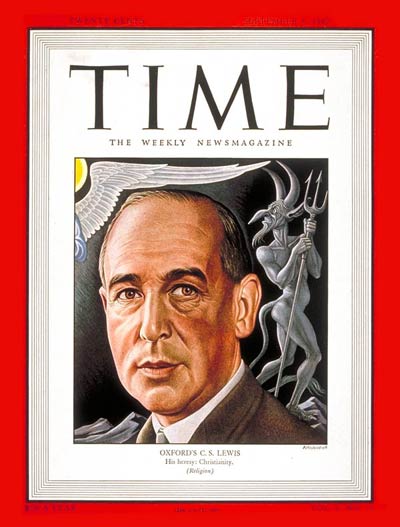 defective view of salvation and was an opponent of the substitutionary and penal view of the atonement (Christianity Today, Dec. 20, 1963). And in a letter to the editor of Christianity Today, Feb. 28, 1964, Dr. W. Wesley Shrader, First Baptist Church, Lewisburg, Pennsylvania, warned that “C.S. Lewis … would never embrace the (literal-infallible) view of the Bible” (F.B.F. News Bulletin, Fundamental Baptist Fellowship, March 4, 1984).
Andrew Greeley in an article entitled, Narnia: Not Just for Evangelicals writes,
C.S. Lewis was not a Christian in the sense of the word that “evangelicals” insist upon. He was an Anglican who sometimes skirted, in his writings at any rate, dangerously close to the thin ice of Catholicism. Indeed, many in my generation of Catholics simply assumed he was one of us. But even as an Anglican he would certainly fall out of the realm of the “saved” when the Rapture blasts all of us who do not believe in word-for-word inerrancy into oblivion.
Despite all this, C.S. Lewis is still considered one of the greatest Christian theologians, thinkers and authors of all time. But why? Of course, disbelieving in the innerancy of Scripture is far more serious than smoking tobacco and swilling suds. But nowadays a Christian author / thinker who smoked cigarettes, drank beer, believed in evolution, felt compelled to pray to Apollo, and rejected biblical innerancy would have about as much chance of becoming an evangelical hero as Paris Hilton does of becoming relevant.
So, given the facts, how “Christian” was C.S. Lewis. . . and why is he an evangelical hero?







Wow, I get to decide how Christian Lewis was? Well, seeing as how I’m going to need plenty of grace to grease my hiney through that narrow gate, I’m going with “enough.”
As to why he’s a hero, to evangelical writers at least, I’m going with “who else we got?” Chesterton and O’Connor, too Catholic. Tolkien unknown (to me at least) outside his mythworks, and then also too Catholic. Sayers too Anglican (Lewis’ “heresies” at least make him less CoE). That said, they’re all my heroes, because again, who else we got?
Thanks for the post, Mike. Got the blood pumpin’ today.
I just noticed how old these comments are…Most are probably dead by now..why don’t u close this site down man@!!!
I have also found it amusing as to Lewis’ status among evangelicals who don’t really know what he believes but love the first part of his Mere Christianity.
As to deciding Lewis’ fate, I’m glad it’s not up to me. I will say that I don’t believe a belief in evolution nor a denial of the doctrine of inerrancy a case against Christianity. (I know you listed more points.) I’m not sure I could subscribe to inerrancy as most people say it (although I would subscribe to infallibility).
Lewis, especially in his book, The Discarded Image, influenced my thinking. While I don’t agree with everything Clive says, I don’t think it’s enough to put myself in the Judge’s shoes. I’m especially wary of taking these quotes and making a call without seeing the context. After all, I too have said that I believe in myth.
Evangels know about Lewis. Most older preachers know his works and his beliefs. I have talked to many over the years and these article make it sound as though the believers knew not their sources. It is really an attempt to justify non believers more than to ‘out” the near believers.
C.S. Lewis has long been my hero BECAUSE of all these things you wrote, not in spite of them. I love the way he thought, he questioned, and he reasoned. I love his honesty. And the fact that he smoked and drank. Lewis was as real as they come. And I can’t wait to shake his hand in heaven.
Mike, good post to make a person think.
I certainly wouldn’t go so far as to say C. S. Lewis was a great theologian. I don’t think that’s what he’s known as at all! He wrote a number of thoughtful non-fiction works, certainly, but was he laying out a systematic framework of belief? He discussed suffering, he explained how he came to faith. And Mere Christianity? Is that a theological treatise?
Be that as it may, you asked how he came to be an evangelical hero. I’d have to say, by becoming a Christian. By writing about things that Christians wonder about–heaven, temptation, suffering, salvation.
As to the areas where he “got it wrong,” I can only say, I’m thankful God doesn’t require us to take a theology test before He opens up Heaven to His children. If that were it, I don’t think any of us would get in because I doubt if any of us have it all figured out.
As far as I know, C. S. Lewis is in Heaven because, just like other Christians, grace saved him, not works of his own.
Becky
Amen… Becky I believe people take bits of what cs lewis said and run with it dragging it through the dirt. They don’t stop to understand who he was.
Take Christopher Hitchens. A heroic figure to atheist and freethinkers. Think about it. A man who preferred men to women sexually, and a Marxist….and thought that Christianity was a myth, and despised Jesus…why would he not? Everything Hitchens loved is what Jesus taught against…Render into Caesar what is his……………man with man..two things Hitchens LOVED!..His adherents are proud to quote him. Enjoyed seeing him debate even though facts never become an issue! So with Lewis, is it not a dangerous thing to impart our beliefs based on what he said? I will listen to Jesus and not a Lewis. The Oxford syndrome is being invoked. He who a has degree from Oxford is never wrong….they will make Monkeys out of you and find another path to salvation.
But CS Lewis is just stated as saying he didn’t believe in grace – or Jesus — Apollo the healer or Tash might be good enough.
Chris, I hadn’t read your comment when I posted the one above.
Evangelicals have plenty of heros, including writers, but perhaps not any that are close to contemporary. To name a few–John Donne, George Herbert, John Bunyan, John Milton.
Becky
Most would agree that the one who saved is the one whose praise as the hero!
Okay, so I’m playing provocateur. But when I started reading Lewis some 20 years back, no one mentioned his “questionable” beliefs. It was only after personal study did I uncover dissenting voices. . . and it made me wonder. I’d come from a pretty strict theological upbringing, so Lewis’ inclusion seemed contradictory to what I’d learned about “doctrinal purity.” Was somebody missing something?
Becky’s right about Lewis NOT being a theologian. Nevertheless, the degree to which he’s quoted and recommended makes me wonder whether or not he actually has acquired “theological clout”. After all, the very title of one of his most popular works — Mere Christianity — suggests something definitive, as if he’s distilling the doctrinal core down to its essence. So, while Lewis would object to being a theologian, the proliferation and popularity of his writing has shaped people’s theologies.
Like Heather, I love Lewis’ take on paganism and myth. Few other views have shaped me and broadened my worldview like this one. I wouldn’t believe it if I didn’t think it jived with Scripture. Nevertheless, it is a paradigm that’s often misunderstood and opposed.
As to Lewis’ popularity among Evangelicals, and evangelical authors, I’m wondering two things: 1.) Does this signal a dearth, a deficiency, in our knowledge of the Bible? In other words, do Evangelicals embrace Lewis because they simply do not understand the importance of Scriptural innerancy, penal substitution and Purgatory? Could it be our uncritical acceptance of Lewis reveals our own drift from sound doctrine? 2.) Regarding writers: I wonder that evangelical authors place more premium upon good craft and good stories than they do on good theology. Perhaps this is how it should be. After all, we’re not preaching, we’re telling tales. Of course, this doesn’t mean we can enact heresy in our stories, but that doctrine is secondary to drama in the world of fiction. Could Lewis’ influence among Christian authors signal an indifference — or, at least, disregard — toward the fundamentals of the faith? At the least, Lewis’ beliefs stretch our understanding of what mere Christianity really is.
Hey, Chris, Heather, Rachelle and Becky, thanks for your comments! Grace to you!
I like CS lewis because he has some very valid points. But I do not read his works as a basis for my beliefs. I believe there is no purer book than the Holy Bible and on its truths do I put my trust and faith in Christ…. Amen…..
Well said Ricky Parker.
Mike,
I don’t think besides the minority of evangelical intellectuals that most evangelicals know what non-fiction C.S. Lewis actually wrote. They are Told that he was a great defender of the Faith-the most brilliant Christian apologist of the last 200 years by pastors or leaders that they trust so they go with it.
I also think there is a British cultural component here. ( Yeah, I know he’s Irish ) There seems to be an understanding in the American mind that a drink and a smoke in the United Kingdom is culturally acceptable so it’s not the scarlet letter that it is here. Besides, no one who writes that well can be that bad. Maybe most can’t even understand what he’s written so they pretend – it becomes accolade by default.
Besides, time has a way of softening perceptions.
He did enough to earn his position and I think the lack of criticism by Evangelicals is a good sign. Although, it is hard to believe that he prescribed to purgatory.
I’m going to have to land firmly on the side of “it’s the places where Lewis differs from Evangelicals where I most love him.”
Frankly speaking, if Lewis hadn’t said things that I never heard clearly in my evangelical Church, I don’t know that I’d be a Christian today. There’s this sense of doubt, of thought, and of struggle that often gets left behind in the excessive optimism and know-it-all-ness of Evangelicals. And personally, I drink (never to drunkenness) and smoke (on very rare occassions), and will attribute both partially to Lewis. If Jesus was falsely accused of drunkenness, I don’t mind if a few people get the wrong impression while seeing me in a bar.
And regarding his view of the scriptures: he once wrote that the OT depictions of God are “allegorical,” because they picture a God who has mood swings and changes his mind. Then he pointed out that all theology of God is “allegorical,” and in any case preference should be given to the “allegory” that God himself revealed to us, rather than the “allegory” that men built to understand God.
I could go further to defend Lewis, but I don’t want to hijack this forums. Was he perfect theologically? No. Do I understand evangelicals love for him? No. Do I think said love is entirely healthy for evangelicals, esp. if they are to actually read what he said? Absolutely.
“But nowadays a Christian author / thinker who smoked cigarettes, drank beer, believed in evolution, felt compelled to pray to Apollo, and rejected biblical innerancy would have about as much chance of becoming an evangelical hero as Paris Hilton does of becoming relevant.”
I respectfully disagree. Check out a bio of Rich Mullins. The guy cussed, chain-smoked, often alligned himself with the political left, and had begun the official process of converting to the Roman Catholic Church when he died. He also wrote the best songs of praise to God and thought about the difficulties of Christian life. He lived his whole life as a humble ministry, at the end writing music to support his missionary efforts to Native Americans. I bring him up to point out that, even in American Evangelical circles, often times people respond to genuine Christians who God has gifted with the ability to inspire others to seek God.
Interestingly, though Rich had a very keen sense of his own guilt before God, he (like Lewis) never considered his smoking to be a sin.
http://en.wikipedia.org/wiki/Rich_Mullins
This post made me squirm! I love C.S. Lewis and I hope to see him when I get to Heaven (I’m certain I’ll be there in spite of my occasional beer-swilling). I’m not big on speculating about other’s salvation. However, this was interesting. Makes me want to pick up the rest of his books I haven’t gotten to and read:) Thanks, Mike.
Just wanted to add that I always enjoy Dayle’s comments (Hi, Dayle.)
Thank you so much, Janet. It’s feels good to be appreciated.
However, it might interest you to know that our esteemed host, Mike Duran, has, through a campaign of intimidation and harassment, tried to keep me from commenting on his blog. I can’t go into detail but it involves three federal agencies, the Japanese mafia, and a couple of tough girl scouts that live in my apartment building.
I’m just kidding, I love Mike.
But then again, why is that unmarked van always parked outside my window. And . . . wait, what is that nailed to my front door . . . Oh no–it’s a thin mint.
Ha! You’re too funny. I’ll pray for your safety. Thanks for taking the risk and commenting despite the threats; you’re a brave man. Take heart; I’ve met Mike in person and he didn’t scare me.
Thanks for your comments, ChestertonianRambler (CR). I’m sure G.K. would be proud. I’m not sure I need to “defend Lewis,” but the degree to which many feel compelled to, is intriguing.
You said: “I’m going to have to land firmly on the side of ‘it’s the places where Lewis differs from Evangelicals where I most love him.'” Not sure I concur. Does this mean you don’t believe in the inerrancy of Scripture or penal substitution, that you pray to the dead, believe in purgatory, evolution and baptismal regeneration? If so, you have issues with Scripture, not just Evangelicals.
Regarding drinking and smoking — name me half a dozen other prominent Evangelical authors / artists who openly drink and/or smoke, and I’ll give credence to your take. While Rich Mullins may have imbibed, his vices were hardly condoned by the mainstream Church. I often sarcastically refer to drinking and smoking as the “morality yardstick” for many conservative Christians. It’s foolish, I agree. Heck, CBA publishers still do not allow cussing, drinking or smoking in their books. Which, once again, makes the acceptance of Lewis all the more anomalous.
I have no problem believing that people with widely divergent views may be saved. Heck, we may even discover some Buddhists and Yankee fans in heaven. So, in my mind, Lewis’ liberal views do not shock me or disqualify him from heaven. Nevertheless, I do not feel compel to defend his divergent positions.
Thanks so much for your comments, CR. I’ll be checking out your site! Blessings!
Buddhists perhaps, but Yankee fans … that’s a bit much don’t you think.
Mike:
Color me confused. Where in the linked “He believed in evolution” speech/essay (just got around to reading it) does Lewis indicate he believes, i.e., adheres to a pro-evolution creed? My read of it says he rejects it as nonsense. He discusses evolution, yes, but to say that makes him an evolutionist is like saying that since I believe in Communism and Cannibalism (I believe they do factually exist) that I’m a man-eating commie.
Likewise, I find Lewis’ statement that the human heart cries out for Purgatory akin Simon Peter telling Christ not to wash his (Peter’s) feet. Grace can be a terrible thing to bear, which is not to say it’s a bad thing. I do not think it likely that Lewis would suggest that the human heart trumps God’s sovereignty or that Christ’s sacrifice was flawed. I don’t recall Edmund having to go through Purgatory after the Stone Table incident.
As far as Lewis feeling drawn to pray to Apollo goes, yes, the temptation was there. But even with the rationalization about the proto-Christ, Lewis did not kneel in front of the pagan altar. To suggest that Lewis is guilty of something because he admitted he was tempted by it is to set the bar dangerously low, and does nothing to encourage spiritual transparency.
Personally, I have problems with reading the Bible as word-for-word literal truth. I agree that the Bible is Truth throughout, but some parts of it are metaphorically, not literally, true. Is God literally a mother hen gathering her chicks? Literally, both female and poultry? Course not. But does the imagery ring True? Yes. Seems that matches up with the allegorical interpretations that are referenced in the comments above.
I’m sure there are points where I’d disagree with Lewis’ beliefs, but these don’t seem to be them. Nor would I suggest that my beliefs be the yardstick we measure by.
In all things, Peace, Mike.
–Chris
Thanks for your comments, Chris. Here’s some better links to Lewis’ views on evolution. Though THIS ONE is unabashedly critical, it has a section entitled ON CREATION with quotes from Lewis like this: From The Problem of Pain, pp.133,77 “… for we have good reason to believe that animals existed long before men. … For long centuries God perfected the animal form which was to become the vehicle of humanity and the image of Himself … [Eventually,] God caused a new kind of consciousness to descend upon this organism” and this “If … you mean simply that man is physically descended from animals, I have no objection” (The Problem of Pain, p.72).
Or you could look at THIS SERIES OF LETTERS. From the intro: “C.S. Lewis infrequently addressed the subject of creation and evolution, and on such occasions he usually endorsed some version of theistic evolution.” From ANSWERS IN CREATION: “. . .C. S. Lewis, is an old earth creationist, who believed in evolution.”
To clarify, I do not think a belief in evolution condemns someone to hell. However, the disbelief in hell might.
You said: “Personally, I have problems with reading the Bible as word-for-word literal truth.” Although I understand what you mean and you explain your thoughts well, to me, this is a potentially dangerous position. (I’ve been thinking about blogging about this very topic.) Of course, some biblical stories ARE metaphorical. Careful, logical, objective readings of the text usually determine what falls in the category of “literal truth.” The danger is when we become arbiters of what’s true and not true in Scripture. As such, I can effectively mythologize anything in the Bible and get myself off the proverbial hook.
Hey, great discussion! Thanks so much for participating, Chris. And I’m looking forward to reading your Cthulu tale in the Diner!
Mike:
Very good points. Strangely enough, I do have issues with Scriptures, but they’re none of the ones I’ve said–on Evolution, I’m an agnostic, having seen convincing arguments that it doesn’t necessarily contradict God’s authorship of Gen. 1 and 2 in order to communicate clearly, poetically, and theologically his absolute control of creation, etc., etc.
I pray for the dead, but only retroactively, which is what I think Lewis was talking about. Praying that the dead reach heaven for me is akin to praying that my mother safely drove home–I know the issue is decided, but not knowing the outcome I ask God (who is outside time) anyway.
But all this is besides the point. The central reason why I defend Lewis is that he provided a voice that I hadn’t heard before, a voice that matched faith in God with hard rationalism and a keen awareness of the struggles of faith. No one else told me, during high school for instance, that “he who has doubted little has believed little” (meaning that the easiest way to not doubt is to artificially shrink your conception of God.) In a sense I defend Lewis as a Christian because I feel that in him I have a very imperfect and flawed guide to the Truth and to God. Sure, I could poke holes in his doctrine if you ask me to–but that’s not the point. When people say, not that he was wrong in details, but that he has no idea what he’s talking about (i.e. is not a Christian, or is a highly deluded one), I find the argument a very critical one for me. If I’ve been finding encouragement in doubting Christians-who-aren’t-Christians, I need to reexamine the importance of human reason and ask myself if maybe all my attempts to draw near to God and let him change me are fundamentally flawed.
Not that I was particularly angry about your particular post. On the contrary I enjoyed it. Just so you can know why I (and my ilk) see Lewis as someone worth “defending.”
About the literal-ness of Scriptures, we could have a long and fruitful debate. The central point that made me a bit more liberal was the point that the Scriptures were written in an historical culture as well as language. Applying the allegorical phrase willy-nilly is of course the best way to declare oneself an infallible Pope, or perhaps even one’s own God. But to hold off on applying a specifically Modern view of language used to express truth might also be to push things a little too far.
In any case, as a Christian author, head of family, and potential English professor the idea of Evolution isn’t necessarily going to hit my fields of interest all that hard. Nor is the idea that Job’s speech was literally what he said, rather than a dramatic and accurate retelling of the true story of Job.
Finally, and unrelated to all the above, I seem to be having the hardest time subscribing to your sites RSS feed via FireFox. Each time I click, rather than giving me the option to add you to my toolbar folder, it brings up a page of HTML-coded gibberish. Know how I can get around this?
CR, try the RSS link in the sidebar, under the sitemeter. Other than that, I’ll have to tinker with it. Thanks for pointing that out.
Do you not know that it is not our job to judge people? And if you are, you need to judge righteously. What you’re doing here is the classic ol’ plankeye bit.
No one ever said Lewis was perfect, and I’m sure he never said he was perfect, but that doesn’t mean he wasn’t a christian. We all need to work out our salvation with fear and trembling, and with grace!
Or have you forgotten about grace? And mercy?
Smoking, drinking, and believing in evolution aren’t things that will lead you to hell! Jesus drank, just in case you’ve forgotten.
You deal with your own salvation and always encourage and love others the way Christ would.
I’m going to have to land firmly on the side of “it’s the places where Lewis differs from Evangelicals where I most love him.â€
Quite.
Contemporary evangelicalism is only one of many small sects, (and I would say heresies), that have sprung up in the long history of Christian theology. It’s an offspring of the Anabaptist cult really, and in the US has accrued both cult-like and wildly commercial and political corruptions. I for one find it in its most extreme examples revolting and vicious, and am eternally grateful to persons like Lewis who have the humility, compassion, intelligence, grace, scholarship, wit, and profound love of God that makes it possible to draw close to mysteries with real wonder and joy. Did he make it into heaven? I don’t want to comment upon the sort of character who would have the prideful audacity to even pose such a question. (I have read every word he ever wrote, much of it frequently, and I secretly call him Jack and hope more than anything that heaven is made in such a way that I, despite the flaws already apparent to anyone who just read the splenetic above, might be met there the door that I never would have found were it not for him.)
Mike, I am in total agreement with you. The call of Jesus is clear, one is not to engage in things that are forbidden. Out of the heart the abundance of the mouth speaks, and from the writings of C.S Lewis I think we can safely say that he had fairly major disagreements with the Bible. The Bible for a Christian is the absolute standard of truth (as naive as some may think this is) and therefore any deviation from this standard would mark him out as not being a ‘Biblically based believer’.
My problem is that the occult is forbidden for followers of Christ, and so I would not want to include that in my reading. I have read Lewis’ books pre my being ‘born again’, they acutally led me into the occult.
The problem with Christians at at large is ‘they don’t wish to look wierd’, they are already substatianlly different from the masses, so in an effort to keep some kind of relevance they cling to various ‘heros’ and urban myths about famouse people repenting on thier death beds and such. Instead of just becoming the ‘peculier’ people that Jesus says they will become they want to retain ‘cool’. So you end up with various, and obvioulsly non-evangelical people becoming holy cows. They look for the slightest notion of Jesus coming from even the most un-holy person and point to it.
They do not understand the call to ‘be seperate’.
So you are perfectly correct in your premise.
*lowers head to avoid swipes.
sorry for excessive typos, bad arm.
I don’t have much to add to this – but it’s pretty funny you bring this up. I remember in my thankfully brief – and largely forgettable – stint in Bible College, in a Lit Class folks talking about Lewis and Narnia with the same respectful, awe-struck tone you’re mentioning.
I brought up the one scene in “The Last Battle” – when one of the bad guys encounters Aslan, expects to get eaten, but Aslan says: “Any prayers you offered up to Tash (the bad guy god) you offered to me, also.” I’ve never had a problem with that SCENE, just had the same problem with folks who look to Narnia as the only Christian fantasy worth reading – because that definitely smacks of Universalism. Again, didn’t bother me, I saw it merely as a plot device, part of the story.
My classmates totally brushed it off. Didn’t even want to hear it. Even questioned if I remembered that scene correctly at all. By the time i unearthed my old copies at home the semester had ended…
Wow! You read universalism into the Last Battle?? The very judgement dividing the redeemed from the condemned plays out in Chapter 14. And you also did not read why the prayers offered to Tash (the bad guy god) were received by Aslan, which might be understood if you had quoted the whole explanation. Indeed, we Christians should be very careful of how glib we can become, for Jesus Himself said “Not every one that saith unto me, Lord, Lord, shall enter into the kingdom of heaven; but he that doeth the will of my Father which is in heaven.” Matt 7:21
And not all the Saved are in the Kingdom of New Jerusalem in Revelation 21.
Bible college, the best place to avoid if you want to learn about God.
C.S Lewis was a closet Catholic, as his great friend Tolkien was a major influence in him becoming ‘christian’. As we all know, the major way for the Catholic church to grow was to assimilate all pagan religions and ‘re-brand’ them e.g Saturanlia (christmas) and others, easter, etc. All roads do lead to Rome for some, whatever the flavour.
I don’t have a problem with Catholics, my family history played out that way, God however has a problem with the doctrine.
Mike,
I am well aware of some of the erroneous views of C. S. Lewis, but I’d like to address his smoking first. It may not have occurred to the 21st Century Christian that Christian mores regarding smoking have not always been against the prcatice. Point in fact, Charles Spurgeon, the Prince of Preachers, was known to smoke WHILE preaching! Can you imagine the outrage today at a preacher lighting up in the pulpit?
I am aware that Lewis accepted evolution, just as I am aware Spurgeon accepted the possibility of the old earth timescale [but rejected evolution]. In regards to some of the other views you’ve mentioned, I think a quote by St Paul and another by Martin Luther sum up my attitude:
“Study to shew thyself approved unto God, a workman that needeth not to be ashamed, rightly dividing the word of truth.” – 2 Timothy 2:15
…which points to our personal responsibility to rightly divide the Word rather than simply take someone else’s word for it. Paul commended the Bereans for taking the time to see if the Scriptures really said what he claimed they did.
“The days of creation were ordinary days in length. We must understand that these days were actual days (veros dies), contrary to the opinion of the Holy Fathers. Whenever we observe that the opinions of the Fathers disagree with Scripture, we reverently bear with them and acknowledge them to be our elders. Nevertheless, we do not depart from the authority of Scripture for their sake.” – Martin Luther
-Rev Tony Breeden
aka Sirius Knott
Great topic and discussion. With no desire to divert from the main subject I feel compelled to make a few minor corrections. Evangelicalism is not a minor stream in Chrisitianity nor is it some homogenous unit. It is also not an offshoot of the Anabaptists (a cult?). Mennonites are direct theological descendents of Menno Simmons and before him Zwingli.
As to Lewis and his theology. His Roman Catholic leanings are hard to deny but then again the same is true of Dean Zoontz and I enjoy him as well. We are all called to be noble Bereans, comparing all things with Scripture for ourselves and jugding what is simply a good story and what is revelation from God.
Not to stir up another can of worms but I am far more distrubed by Evangelical love affair with The Shack. It is neither good theology nor good writing and when I read reviews that call it the Pilgrim’s Progress of our generation I want to say a prayer for John Bunyan’s sanity. Then again, I don’t believe in praying for the dead. And, I can’t wait to take my grandchildren to see Dawntreader.
Great article Mike. I wonder how Lewis would answer the question: Do you consider yourself an evangelical? But then “evangelical” meant something different in Lewis’ day than what it has evolved into today.
I think you’re biased toward your own denomination and this article reflects poor research and is written rather badly. I read this article as your opinion. I disagreed with those parts I did not find humorous(which was most of it).
I consider myself a fan of C.S. Lewis, but I do not consider him one of my “heroes.” I believe that evangelicals can properly appreciate Lewis only if they take into account everything that Mike has written here and then some. While I think those who have called Lewis’s Christian faith “a myth” are simply being vindictive, there’s no questioning the fact that Lewis himself did not consider himself and evangelical, and we shouldn’t either.
So to answer Mike’s question: I think that evangelicals have embraced Lewis to the extent they have because he was a high-profile convert from atheism who wrote very engaging prose, including apologetic material, and he was a living demonstration that one can be an intellectual and yet believe in the supernatural at a time when many were heralding the triumph of the Enlightenment in Western culture. And yet not every evangelical has been guilty of the actual hero-worship of Lewis, any more than have most evangelical admirers of the Roman Catholic G.K. Chesterton.
Meanwhile, whoever it might be who has the cheek to dismiss what Mike has written here as biased, poorly researched, or simply his opinion, just flat-out doesn’t know what he’s talking about. Such a person is disagreeing with the facts, and while one may be entitled to his own opinion, he is not entitled to his own facts.
How Christian was Lewis? He was in Christ, and there are no degrees of that. How Christian was his life? I would have to say average, but then again I don’t know what he was dealing with in his past, so lets leave that up to God. He had lousy theology. Like almost all Arminians he was inconsistent in his beliefs. Why is he a hero to so many Christians? Because he wrote so clearly, and powerfully on evidential apologetics, and Christian living. If the Lord does not return for a hundred years, Lewis will STILL be the most widely read (Arminian) Christian writer of the 20th century. I have over 30 books by Lewis, and Duran must have searched hard to find the worst comments by Lewis for this article. Next I would like to see mike Duran write on Legalistic attitudes in Reformed circles. Things like Exclusive Psalmody, Strict Sabbatarianism, No holidays, etc.
Lewis didn’t believe the gospel of God’s grace, election, predestination, etc. How can he be a child of God?
Because Lewis believed in the central fact of Christianity (the Resurrection) and the central doctrine of Christianity (the Atonement).
by the way, I need to be clear that I was the author of the previous post about “central fact” and “central doctrine”. I trust the other Chris on this thread would not be worried about potential confusion, but I do not want to open the door to any confusion. Blessings to all here, \
— Chris Curzon
Excellent post. I heard the same and I think it is a desperate attempt to associate an author from the upper echelon with Christianity. At the same time that association did not make me want do delve deeper into his work to find out just how serious he was about Christianity. Perhaps he was a false teacher, if anything.
How many among us — any of us — could describe a correct view of any theological topic in a way that God would approve??
Would God be more inclined to LAUGH — “You mean THAT’S what you think I AM???”
Or SCORN — “You mean you are more concerned with figuring out who my followers are than of BEING a follower of ME?”
These kinds of post hoc determinations that this author, or that artist, or some music leader was or was not Christian, are only opportunities to weigh imperfect human beings against imperfect theologies. They are more of an opportunity to distract our focus from the living Lord Jesus Christ than anything else.
The question is, indeed, a challenging one… but it admits no answer.
Nice Blog. Sign me up!
I’ve long thought that referring to C.S. Lewis as a Christian was a bit like saying Norman Vincent Peale was a Christian. To the church-goers, it’s probably a true statement. To the born again believer, however, it’s a fantasy – much like his series. (All that said, I must now confess that I so loved Narnia that I own it. Sorry!)
I like your piece, of course; but you won my heart by quoting one of my heroes, Dr. John Robbins — whose book on Roman Catholicism I quoted extensively, in my manuscript “Fully Recovered Catholic.” He read parts of it, before his demise, and gave it a thumbs up – a response I will always consider an honor. http://www.trinitylectures.org/product_info.php?cPath=21&products_id=73
Anyway, nice meeting you, brother. Your FB Friend Linda Freeman sent me.
As a born again believer, I’m quite convinced C.S. Lewis was a Christian. Without picking a fight, I do want to ask, How is this a fantasy?
Respectfully,
Chris Curzon
No fight necessary. Mike Duran’s piece explains very clearly how Lewis’ “Christianity” was a fantasy. If you can’t see this, then I’m not sure where the problem lies: with the fantasy or with your confession of faith – ?
In response to Chris and Sharon, and just to be clear: I use the phrase “How Christian was C.S. Lewis” rhetorically. I believe we are on dangerous ground when trying to make final judgements on anyone’s spiritual state. I deeply respect Lewis, have benefited greatly from his writings, and believe his iconic status is somewhat deserved. Nevertheless, he does not not fit tidily within an evangelical framework. The point of this post is to ask why evangelicals seem to disregard Lewis’ “non-evangelical” components. Thank you both for commenting!
Perhaps the problem lay with Mike’s quoting Robbins list of 5 particular beliefs which seem to hold a weight greater than Lewis’ own stated belief in the Resurrection and the Atonement.
So I suppose my question is really this:
Given that Lewis accepted the Resurrection as a historical fact and the Atonement as the principle Christian doctrine, how conclusive is Robbin’s argument (cited by Mike) that Lewis did not go to heaven “if he believed what he wrote in his books and letters”, specifically:
1) belief in purgatory
2) belief in evolution
3) tolerance of paganism (I think this is overstated by Robbins)
4) belief in prayers for the dead
5) “soft universalism”
To the point: How is it that these five beliefs, a fortiori, nullify Lewis’ stated belief in the Resurrection and in the Atonement?
Since Robbins is not around to answer this, I would be interested in any answer you, Sharon, or you, Mike, wish to provide.
Sincerely,
Chris Curzon
Or to put it another way…. how does
1) belief in purgatory
2) belief in evolution
3) tolerance of paganism (I think this is overstated by Robbins)
4) belief in prayers for the dead
5) “soft universalism”
become MORE SIGNFICANT than belief in the Resurrection and the Atonement?
Sincerely,
Chris Curzon
Like Mike, I find discussions of the worth of others’ faith to be troublesome.
As far as Lewis goes, like the rest of us he certainly harboured some window-dressing theories that are neither indicitive of the intensity of our faith or combative with Grace.
Lewis was reared in a different culture and tradition, and many of the ideas that Mike has thumbnailed for us are as much a byproduct of culture as the Evangelical “no drinking/no smoking/ no dancing” teachings. They certainly are NOT barriers to salvation, as I understand the presentation of such in the Gospel.
I find it a good thing that so many are willing to embrace Lewis’ intellectual approach to the faith, and see many Christians challenged by it.
Yet I assume we all know that Lewis was neither Holy God Incarnate nor an anointed apostle, so we understand that some of his opinions (like some of ours) might be a bit wonky.
As to the position of salvation for the Roman Catholic…can we not go there?
“As to the position of salvation for the Roman Catholic…can we not go there?”
I find this to be a troubling perspective (wanting to avoid the conversation), as denying that Catholicism is a false religion dismisses the fact that its members are a mission field of 1+ billion people who need to hear the true gospel.
Most definitely a discussion to be had.
Mike wrote: “I believe we are on dangerous ground when trying to make final judgements on anyone’s spiritual state.”
You miss the point. Is the teaching of Lewis evangelical, is it safe?
Answer: no
Mike said: “I deeply respect Lewis, have benefited greatly from his writings, and believe his iconic status is somewhat deserved.”
What are you talking about? This is nonsense. How can this be true about you?
C.S. Lewis is a sacred cow. People who love innovation love him, those who are not playing games don’t.
Did Lewis bring glory to the person and work of Christ? No. Anyone who loves Christ will not be into Lewis. The love of Christ has heat and zeal, and loves those who magnify Christ.
In general, your argument makes wholly unsupported claims. You say Lewis “did not bring glory to Christ…” but you quote nothing from Lewis proving this point. For contrast, you might define what WOULD constitute bringing glory to Christ, so that we might learn.
So your argument is a vote against. But otherwise, it is empty. Claims without support.
I would add that you directly denied a personal statement made by another. A statement you can have no knowledge of that would make you able to correct.
When Mike said “I deeply respect Lewis, have benefited greatly from his writings, and believe his iconic status is somewhat deserved.”
You dismissed it completely. “This is nonsense.”
And you know this is nonsense because…. ?
— Chris Curzon
Mike, you are obviously zealous, and for that I commend you, but you cannot possible know whether Lewis brought glory to Christ! You can however, discuss the specifics of direct quotes that he an made, and whether they are in line with the Bible (or your unique interpretation of the Bible). What you are engaged in is libel, which does not bring glory to Christ. Christ alone will be the ultimate judge of Lewis. In Mere Christianity, Lewis defends ALL the fundamental doctrines of the church, including salvation by grace through Jesus’ death and atonement. Insomuch as he was possessed of such faith, he was as saved as you or I.
^above was directed @Jim (not Mike) 🙂
Did Lewis bring glory to the person and work of Christ? No. Anyone who loves Christ will not be into Lewis. The love of Christ has heat and zeal, and loves those who magnify Christ.
Nice to meet you, Christ!
Allow me to explain. I was a big fan of Lewis. I read his Space Trilogy, and the Narnia Series many times. But now I feel like a dupe, and wonder where our heads are at.
In book one of Narnia, the “atonement” is presented as a sacrifice made to the devil. No allusion to God’s wrath being appeased, no allusion to Justice being made, just pagan, Romanish, flat-out error on one of the most important truths known to mankind.
Now tell me this: why is this allowed in a kid’s book? I am ashamed of myself for being so cold hearted toward the Lord and His work on the cross. I have given this book to a child to read! I told a nine year old boy who trusted me that it was Christian! What kind of a spell was I under?
In the story of Perlandra, what did we get: two humans in bloody combat. And this was the redemption of Perlandra? What a missed opportunity, what a waste of time, what clutter and confusion. What about the last book, That Hideous Strength? What did we get there? Sensuality, perversion, drunkenness, gore, darkness, wizards, spells being cast, decapitated talking heads; come on! Where is Christ’s real person or real work glorified in any of Lewis’ work? How can a man bring glory to Christ if he does not understand what Christ did on the cross?
And yes, I don’t get how Mike can say he was helped by Lewis.
Is this question irrelevant? Did Mike step over the line? What happens when we follow the line of cows, where does it lead? Lewis had it wrong. Billy Graham had it wrong. Rick Warren has it wrong. Sacred Cow John Piper is warmly connected with the last three cows who are not Evangelical (I spent years following Piper). Piper says Lewis was a major inspiration to him, he gives tribute to Graham on his website, and he flat-out indorses Warren. What do we make of this?
Why is it so hard for us to call an ace an ace? Why do we like those who mix things up? Is it not our job to stay separated from error and call it out? I need this from leadership, and I am not getting it from the well-known. I am a dumb sheep, with limited time.
I have been a fool. I have bought into this slop big-time, but now I am moving on. No Christian worth the name has any sacred cows.
You ask what does giving glory to Christ look like? Here is a short book by A.A. Bonar, “The Gospel pointing to the Person Of Christ”. Find it online to read. It will bring you joy in a few short pages!
Thanks for giving your ear to a stranger for a few moments,
Warmly in Christ,
Jim
Wow. Jim – your reading of The Lion the Witch and the Wardrobe is so faulty it’s scary.
Aslan sacrifices HIMSELF to himself. And allows himself to be killed by the witch in accordance with the old prophecies. Similarly Christ offered himself to be killed by Satan and his forces, in accordance with the old prophecies.
The sacrifice was not TO the devil, it was OF God, for sinful mankind as represented by Edmond.
Note: understood correctly – that Edmond had to die as a traitor, that Aslan gave himself as propitiation to that law, that Aslans death both frees Edmond and breaks the spell of the witch – the story maps precisely to the penal substitutionary understanding of the gospel.
The reason you reading is scary is this: if you so eloquently and blithely misunderstand Lewis so badly, imagine how eloquently and misunderstand scripture! Image what distortions your inability to read must bring to the text! Imagine the danger you pose to all who read you…
Thank you, Jim, for your thoughtful and passionate response.
Per your suggestion, I was able read online “The Gospel pointing to the Person Of Christ”, by Alexander Bonar. I will wholeheartedly agree with you, for the part that I have read so far, Chapter 1, of what Bonar wrote is truly excellent. It so well describes the Gospel, that it takes my breath away. His ability to communicate is outstanding. Now, I’ve only finished chapter one, before deciding to write this reply to you, but I look forward to the remaining chapters.
Of your regard for Lewis, I will make just a few comments. Regarding Perelandra, I have mixed feelings about the very conflict you mention. But Lewis is not explicitly presenting the Gospel in that book. He is doing something rather different and exploring what the struggle of the Fall might have looked like, and what it might be like if the Temptation were presented, but rejected. As for “That Hideous Strength”, yes, it IS about everything that you say. But it’s purpose is not so much to present the Gospel, as it is to teach us what the works of Satan could look like, and how the human soul can be corrupted. And not so much in the abstract, but through a fantasy set of events that feel like they could actually happen. It’s a warning: Be vigilant.
That’s it for now. we have different views of Lewis, but quite the same view of the Gospel. The glory that belongs to Jesus Chris alone, we both affirm. What Jesus did is breathtaking to contemplate, and only grows more so, the more I think about it. I’m going to write again, after finishing the whole book by Alexander Bonar.
God bless you,
Chris Curzon
I am aware of the above things in regard to C.S. Lewis, although I have also read that Tolkien and Lewis considered Christianity the greatest of all myths – not in the same vein as Greek or Norse mythology, but as a kind of fulfillment – a myth come true, if you will, or the greatest (true) story every told. For my part, I am a Christian apologist, and have been defending the faith thus far for about three years. I have read several of his works, and although I may not agree with everything Lewis wrote, I nevertheless find many things that Lewis wrote useful. Again, I do not agree with everything that he penned, but as with other writers, aside from Scripture, that is; I tend to read a work and filter out the bad and hold on to the good. Did Lewis believe certain things that Evangelicals do not? Evidently. Does that mean that I am going to be a fierce critic and devalue many things written by this man, whom I still consider to be brilliant? Not at all. On the contrary, I also share Lewis and Tolkien’s love of myths (particularly Greco-Roman mythology), but as opposed to claiming that the Bible was influenced by such things, I rather use them to support the Bible. For example, Judges refers to Samson, who had remarkable strength and was recorded as tearing apart a lion with his bare hands – in Greco-Roman mythology, Hercules/Heracles was also a strong man who defeated a lion as one of his twelve labors. In other words, I am of the mind that Hercules/Heracles was based on the historical Samson. This leads down another discussion, however, one that I do not intend to engage in. I am simply commenting to note that the article was well written, and I acknowledge the man’s flaws, yet also believe that he is in heaven by faith in Christ. I do apologize for a bit of a rant, but I have been a fan of Lewis since I was a child. He had some remarkable ideas, if anything, and several of these ideas (though not all, of course) are very positive and useful in nature. God bless you.
Hello Troy,
You believe a man can go to heaven who believes wrong about the person and work of Christ. Why? Because he is brilliant?
This is not safe thinking, nor is it safe teaching.
I will grant that some of his ideas on culture were useful (I just read All God’s Children and Blue Suede Shoes, great book!). So I agree that a person can be useful and helpful who is not evangelical.
My main issue is this: what right do you have to pronounce him saved? Are you not gospel-centered in your life, in your faith? What is your hope, that you are brilliant?
If sin were the standard, we’d all be disqualified. Lewis was just as flawed as the rest of us yet God has used him (still to this day) to display His invisible qualities.
I was a bit confused about this article…
Wouldn’t you agree that, whether a person is cristian or not, decides by his acceptance of god’s grace and love? And definitely not by his level of perfection! (compare 1.John 4,17)
At the end of the day, we will have real big surprises in Heaven..just make sure you make it there first!
I know this a late post to an old topic, for that, apologies! However, the question that this post and many of the following comments bring to mind is this-when did evangelicalism become the “only true way” for Christians to believe? As a rather late comer to Christian history, will people really discount 1600 years of Christian history because it didn’t match up perfectly with the evangelical framework?
Josh,
Are you a lover of Rome? Fly your colors man, let us know what is on your mind.
@Jim: What about Luther’s Reform? What about Post-Calvinist Reform? What about the Protestant Reformation (out of which sprang Anglicanism)? What about the the Anabaptist movement? What evangelical disagrees with 4th c. {catholic} writer, St. Augustine, en toto? Why are you accusing Josh of being a “lover of Rome” for pointing out that the evangelical movement does not represent the sum total of Christianity?
(from my post on Facebook) In Mere Christianity, Lewis upholds all of the fundamental doctrines of historic Christianity.
It is this core that all Christians can agree upon; the rest, as he says, are ‘in-house’ arguments that are not essential to the nature of God, His revelation of Himself to us, or the Gospel.
You or I may disagree on much of what Lewis believed around the periphery, but he is saved by belief in the same Gospel as all believers.
To impugn Lewis’ Christianity for hanging out at the pub is simply ludicrous; Christ himself came ‘eating and drinking’.
Lewis is appreciated in Christian circles (even evangelical) because he gives us a how-to guide on apologetics that allows us discuss Christianity intelligently with our secular friends.
In addition, Lewis was a harsh critic of Materialism and Naturalism masquerading as science in which the absence of God was a forgone conclusion based on philosophy.
This parallels evangelicals’ struggle with evolution being taught as final fact, and claiming to function as a proof against the existence of a creator (which it most assuredly does not).
Ravi Zacharias, a Catholic, occupies a similar position as “the great apologist of our time” (according to Chuck Colson) with evangelicals, even though he does not line up on all doctrines.
The Nicene Creed was commissioned by the pagen Constantine. He laid the foundation for most basic church teachings today. By the way he killed his son and wife as well so ….
Noone should be the judge of who goes to heaven, but God know the heart better than any man. St Peter is not going to be asking any questions about evolution at the pearly gates I am sure. But that we have lived pure and victorious lives.
From C S Lewis’s writings I would think that he had a hidden life with Christ in God and God will be the judge.
Hey Mike – thank you for the article.
I think the title is a little vague – perhaps it could be adjusted to read, “How “Dispensational / Fundamentalist” was C.S. Lewis… and Why is He an Evangelical Hero?
Lewis lived what he believed – you tried to make two points out of Purgatory and praying for the dead. The fact that Lewis believed in Purgatory means of course he would pray for the dead! Are you finding fault with Lewis – that he would ask God to have mercy on the soul of a departed friend? He is not praying TO the dead, but for them. Was it wrong of Lewis to believe that God has the power to decide the fate of a man’s soul? Was it wrong of Lewis to believe that God could do anything for the dead – especially since evangelicals have declared that person’s fate already sealed? Both Abraham and Moses interceded on behalf of those whose fate was already sealed (but they were Hebrews – not evangelicals…LOL)
I am not a believer in Purgatory – but I like the doctrine – it comes across as fair in my mind. There is about as much evidence for Purgatory as there is for the Millennium or the Rapture (a doctrine that did not gain popularity until the 19th century) . Perhaps – before we pass judgment on one of our brothers from the past, we could spend some time encouraging our brothers and sisters from other denominations to faithfully live out what they believe. In the spirit of Romans 14 – we can say that there may be some differences in the way we practice our faith – but all those who believe, declare and live the Lordship of Jesus will share in his inheritance.
Have you considered the fact that in his day in Europe smoking and drinking were not seen as sinful things, but rather, it was a part of their culture. Smoking and drinking are only seen among fundamental Christians in the United States as a sign that a person is not a Christian, but let me offer this arguement, Jesus drank, does that make Him not a Christian? I am 16 and know this much, it is a sin to drink to get drunk, but it is not a sin to drink any alcohol.
I’m not advocating alcohol, I am just pointing out that just because he drank and smoked, this does not make him a heathen/nonbeliever. I don’t and won’t drink, but that is just a personal choice, I know many Christians who do drink, again I am not supporting this at all.
C.S. Lewis is a thinker everyone wants to claim. Heck, Reformed theologian Douglas Wilson has labeled him a “time-travel Calvinist” (a claim that I think is wishful thinking at best on Rev. Wilson’s part, but that’s beside the point.) Evangelical critics of Lewis have a point, from their own perspective. Lewis was not evangelical, he shared little theology with evangelicals, and, as an example of just how un-evangelical he was, I will testify that he was a key influence in my own journey out of evangelicalism and into Eastern Orthodoxy.
If you look at Lewis’s thought, he was clearly a high church, catholic Anglican. Catholics and (especially, IMO) Orthodox Christians can share a certain affinity for many aspects of his thought, but if we are intellectually honest, we will have to concede that he is not part of our tradition per se. Evangelicals have even less in common with him. That being said, I think I can explain their attraction to him:
Lewis has no particular attraction for evangelicals as such. Rather, he has an attraction for people. His theology is true on a lot of points where much of the Christian West (and especially low church Protestantism) has gone astray. Because it’s true, it makes sense, and also because it’s true, it resonates with the human heart, because the human heart was designed to work within the framework that Lewis so well understands.
All that being said, if you are committed to the evangelical tradition, you had better reject Lewis (and anyone else who’s studied classical philosophy and theology, or church history, or been steeped in Arthurian romance or Greco-Roman myth or Renaissance art…). He is not yours. He will not help you. From their own angle, the evangelical critics of Lewis are completely right. He represents a tradition of Christianity alien to their own. He is, if I can be pardoned for returning for a moment to the theological language of the tradition I was raised in, downright romish on numerous points.
If you want your children to remain evangelical, by all means do not let them read Lewis. Or Tolkien. Or fairy tales. Or myths. Or witness a Latin Mass or the Divine Liturgy of St. John Chrysostom. Don’t let them hear a Gregorian or Byzantine chant. Never show them a Gothic cathedral. Don’t let them hear classical music. Let them keep thinking that miserable “communion table” is an altar. Don’t let them see a real altar. Don’t let the longing for beauty mystery and awe and eternal glory made manifest on earth awaken in their hearts. Because you won’t win them back.
Once I was saved, I had no more relish for Tolkien or fairy tales or Latin masses or any of that. Don’t know how anybody could leave Jesus to go after that kind of stuff. Sounds ridiculous.
Brad – Did you say that in order to read Tolkien or fairy tales, attend a Latin Mass or even listen to a Gregorian chant that you have to leave Jesus? How did you reach that conclusion? Does the world hold no beauty for you?
I too rely on God’s grace through Christ to get into heaven. Smoking cigarettes and having a brew once in a while is not a sin per say. Lewis has caused me too look hard at some of the leagalisms put on us by Churchianity. Things that come under the heading of touch not tastes not handle not that Paul warns us to reject as leagalism. We are exhorted to earnestly contend for the faith that was first delivered to us. If C.S. Lewis believed these things he is probably not a Christian. We already have a hero Christ, and we do not need any other.
I think those things (smoking, drinking) are a sin, per se. The grace of God teaches us to live soberly, righteously, and godly (Titus 2). Why can’t I see the Apostle Paul say, “Ahh – those legalists – give me a cigarette!”? Because he said that we knew how godly and unblameably he lived. It’s easy to call something “legalistic” because you don’t want to admit that few people are really saved. You’re not saved by not smoking, but I don’t see how someone who has found Jesus can need a “prop” like that any longer.
It would be interesting to ask, if it were possible, how many things we NOW know to be polluting of the body, but which were not known to the people of Apostle Paul’s time. We know smoking tobacco is harmful to the body, but does that make it sinful? What about those people 100 years ago, for whom smoking was not known to be harmful? Were they still in sin?
There is some freedom in these matters. Eating food offered to idols was in a middle area. Paul was free to eat such (1 Cor 8), but often refrained having a merciful attitude to those of his brethren whose conscience might be troubled by it. So I think that we need to be careful against raising up hard boundaries, which even the Apostle Paul would not have done!
It’s not hard to love many of C.S. Lewis’ writings. The sacrifice of Aslan in The Lion,
The Witch and The Wardrobe has always moved me. A reflection of the sacrifice of The Lion Of Judah? I have to admit though, that I went to hear a speaker on Lewis and his writings right after the movie and I took him aside at the end of his talk and shared this with him. I once practiced the occult. Then, after becoming a Christian I have counseled people demonically oppressed.
One of the persons I counseled years ago had a figure of a half-man half-horse lying upon her every night … driving her crazy. After we found out why it was there and renounced the open door we prayed and it left. Now, this is what I asked the professor giving his talk on Lewis. Should we use images that represent other gods or represent evil and picture them as good? It was clear to me that what the lady had experienced was a demonic manifestation…. Then, what about Christian fantasy? Can we say some dragons are good? How far does our freedom as writers go? Often puzzled.
C.S.Lewis is dead . Or is he ? The Bible says that ‘the soul that sins , shall die ‘ In 1 Cor 15 Paul says ‘If only in this life we have hope in Christ we are to be pitied…..if the dead are not raised ….’ Is Paul saying that apart from this life there is no human life after death Apart from Resurrection ?.
If so , where does that leave the popular teaching that ‘souls’ of dead people are alive in heaven , Hell , purgatory or Limbo ?.
Thanks for a great article on C.S. Lewis. Whereas most of those replying didn’t like it, I did. Why does someone have to smoke and drink and whatever else to be “real”? To be “as real as they come”? I don’t want to be “as real as they come” – I want to be made different by the grace of God only. Can’t we be real in Jesus and in getting close to Him, rather than being “real” in the sense of being “free” and being “world-conscious”? Some of Lewis’s statements are interesting, but to put him on a great pedestal is a bit nauseating. Some of his writing doesn’t seem to be that edifying, either, in my opinion.
It seems that this is less a problem with Lewis, and more of a problem with Christians’ reading and thinking skills. “What do they teach in those schools?” And our ability to pass on a balanced faith to our children.
George MacDonald is my favorite universalist. Dietrich Bonhoeffer is my favorite liberal theologian. Making statements like this angers some I know who like their work, but do not understand how much their ideas affect their work. However, I find it best to know the worst about a man and to appreciate the best, than to appreciate a man as an icon, ignorant of some of his humanity.
Thanks for yet another great thought-provoking article.
It’s a shame that in your post you tried to determine whether C.S. Lewis was saved by whether he:
1. Believed in purgatory
2. Believed in evolution
3. Had ever been tempted to pray to another god
4. Believed that God could reach people in other ways
5. Whether his understanding of salvation was deep enough
Reminds me of the time that Christian leaders sat around discussing whether Mary Magdalene had blue eyes or green, while the Mohammadeans destroyed their city. Also reminds me of this joke by Emo Philips: http://www.theguardian.com/stage/2005/sep/29/comedy.religion
Our salvation doesn’t depend on whether our theological views fit with yours, but whether we have trusted that Christ’s blood has paid for our sins. And he certainly did that.
Remember the thief on the cross? All he did was to ask Jesus to “…remember [him]”. That was enough to save him. His beliefs on purgatory, temptations, scientific understandings had nothing to do with it.
As soon as someone quotes CS Lewis- it’s over- I do not listen to another word. I’m not a fan of his writings and don’t think they should be sold as “Christian.” Thanks for the post.
Thank you for posting the truth about c.s. lewis. We may appreciate what a mere man may write, but when other Christians start pointing out facts about the man that do not line up with scripture, we had better put up the red flag about c.s. lewis. Our loyalty to Christ must be our first priority as Christians, and anything outside of His truth should be shunned. We are living in a time of compromising Christianity. If we can’t die to a man’s writing for the sake of Christ, how will we ever stand against what is coming.
Hello, i read your blog occasionally and i own
a similar one and i was just wondering if you get a lot of
spam feedback? If so how do you stop it, any plugin or anything you can advise?
I get so much lately it’s driving me crazy so any support
is very much appreciated.
Wow! The hypocrisy of “Christians” judging others here is unbelievable! I guess all Catholics are damned by your logic? I know so many Baptists, Methodists and many other protestant brethren that smoke and drink beer and they don’t think much of it even when I politely point out that they shouldn’t be doing it. It’s ironic that as a Catholic myself I don’t smoke or drink. I don’t judge anyone but, try to live according to Christ’s teachings and practice love towards all and preference to none.
Strangely, I am a former atheist and “The Screw Tape Letters” was one of the first books I read that helped me to see that forgiveness and salvation is never too late or impossible to achieve as long as you accept Jesus.
God Bless.
Actually, Catholics are damned by scripture, not logic.
Dismissing Catholics as already-Christians dismisses a mission field of 1 billion+ people who need to hear the true gospel.
Mike, the problem with evangelicals like you is narcissism. You think you have the powerful position to judge wether a person is qualified to get into heaven. You qoute some parts of the bible to fit your position. When did Jesus say that being saved guaranteed you anything. He warns at the end of the semon on the mount to put His teachings into practice or you may even be rejected. Humble yourself pal!
I discovered Lewis as I was completing three years in a hyper-strict fundamentalist Baptist high school. I cannot tell you how happy it made me that he smoked and drank. A Christian with a couple of habits that weren’t squeaky clean? A Christian who didn’t hide behind a plastic facade and pretend to be perfect? At last! Hallelujah!!
I study C.S. Lewis. Did he ponder things that don’t line up with classical evangelical opinions? Sure he does…he’s an intellectual and is not afraid to question and ponder many things. Other than the core of the Gospel, most concepts in our faith are open to discussion. C.S. Lewis’ famous quote about Jesus “…A man who was merely a man and said the sort of things Jesus said would not be a great moral teacher. He would either be a lunatic — on the level with the man who says he is a poached egg — or else he would be the Devil of Hell. You must make your choice. Either this man was, and is, the Son of God, or else a madman or something worse. You can shut him up for a fool, you can spit at him and kill him as a demon or you can fall at his feet and call him Lord and God, but let us not come with any patronizing nonsense about his being a great human teacher. He has not left that open to us. He did not intend to.” Should put to rest anyone who thinks he wasn’t really a Christian or did not go to heaven. He obviously believed in the Lordship of Jesus Christ and that Jesus was who he said he was and is the way to salvation – don’t be afraid to THINK – too many Christians are good at parroting their preacher or some denominational rule book instead of engaging their brains like Lewis did….he is one of the greatest Christian thinkers ever…don’t fear thinking!!
I won’t judge his Salvation but he certainly has many doctrinal problems.
I enjoy the Space Trilogy.
I believe, at a glance at least, that Lewis was revolutionary regardless of passed judgments placed on him. If we were to place everyone’s thoughts on the chopping block as Lewis done willingly himself I think many people would find inconsistencies of different proportions. Do I think he should be followed and quoted as if he is the chosen disciple of Christ? Absolutely not.
While there may be many problems in his world view or logical conclusions, one thing is for sure – I would hope in the man’s salvation regardless. Not only, but as easily as I see men fall into the pitfall trap of evolution, Lewis doesn’t seem to have fallen for such. He believed only what could be reasonably asserted within Christian belief, and laid hold of Christ as being God.
The man was not of science, but logic. Much is assumed by pulling bits and pieces of text with his thoughts laid out for all to read, yet context is left hidden in the original document excerpted from or even more so hidden within history itself without record.
While I may have personal disputes with his overall views or particular statements, the piece I just read from, “Is Theology Poetry? which is found in They Asked for a Paper. (1962 Geoffrey Bles London 211 p.),” leaves me wondering why the link to such a piece would be labeled, “He believed in evolution.” In fact, the man more than once stated his renouncement of the theory altogether and also stated his reasons.
No, I don’t think he is a master evangelical, or even a hero of Christianity. But I believe he was a Christian and a flawed one as every Christian is. Yet let us not forget Romans 14:4. As everything in life is tainted, and I have known myself in the past to hold faulty views, I believe his work is of good use for God’s glory. I would take everything he writes with a salty grain, and would check it against the Bible as I do with any author. Would he be offended if I did? Far from it… I believe he would encourage it.
A text from Miles Mathis on C.S. Lewis:
“There’s Something Wrong with C.S. Lewis – and it isn’t what you thought”
http://mileswmathis.com/blarnia.pdf
Only the Scriptures correctly exegeted is the Word of God
CS Lewis has been Satan’s mystical tool in the Church for over 50 years. He was a Universalist, believing you could be saved “without knowing it.” He was an evolutionist which rejects the authority of Scripture.. He called God, a ‘dynamic pulsating activity’, (which false teacher TIm Keller has copied), he promoted an un-Biblical ‘wordless prayer’ where you just imagine the faces of those who you want to pray for (but don’t use any words). This was most likely taken from Buddhist Thomas Merton who he admired. He also erroneously said that God was going to ‘make us into gods and goddesses.” His rhetoric also echoed Catholic Brother Lawrence who tried 24/7 to ‘practice the presence of God.” (as if anyone can) “Narnia” was saturated in occultism and is applauded by every occultic on the planet. Lewis revered his occultic friends and applauded their un-Biblical writings. He claimed to have out of body experiences. He mocked the Psalms and Jesus. And, “Mere Christianity” has NO, NOT ONE Bible verse included. Check out the article by the Trinity Foundation on “Was CS Lewis really saved?”
In his essay, The Abolition of Man, he argues at
length that all morality is founded in the Tao, an ancient Chinese concept denoting the dualistic harmony of the universe. – NOT CHRISTIAN
He was an occult writer. No hero but a deciever.
Good article by the way!
He was, he wasn’t… who gives a damn? Either he was, according to some, or he wasn’t, according to others. He had awful theology, according to some, and good theology, according to others. His smoking wasn’t sinful in 1956, but in 2023 it would have been quite sinful.
This comment section is piffle. Who cares if he was or wasn’t a “true” Christian? None of us will ever know, but each of us will chose whatever answer makes us feel warm and fuzzy.
I will be meandering on my merry way.